This granted men lawful, equal opportunities. Children weren’t limited to their poverty and would be able to prevail. The estates had no higher power over each other. The first and second estate couldn’t dominate the third and vice versa. They were collectively the National Assembly.
Those in the third estate were probably intimidated by the first and second more powerful estates. The tension alone anticipated more conflict. This inhibited a civil war, thereby protecting families. Only officials disciplined, implying that privileges were basically irrelevant and all families had the freedom to exercise liberty.
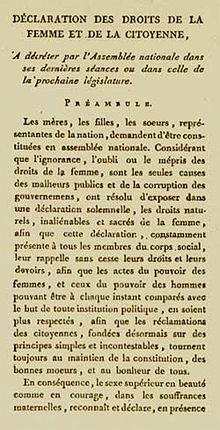
In 1971, French activist Olympe de Gouges was actually moved to write the Declaration des Drots de la Femme et de la Citoyenne, or the Declaration of the Rights of Woman and the Female Citizen. Gouges was born in southwestern France into somewhat of a bourgeois family. Additional to being an activist, she was also a playwright, an abolitionist, and a feminist whose works are renowned in history. Her response to the Declaration of the Rights of Men and the Male Citizen expressed the biased nature of the French Revolution. She believed that the Revolution was not a success; however, just her ambition was a result of the revolution. In 1793, she was executed for “opposition of the death penalty.” Her strength has lived ever since.

